Oct 1, 2026Testing Standards
UN38.3 Testing Guide: Lithium Battery Transport Safety Explained
The eight UN38.3 tests that lithium cells and batteries must pass before air, sea or road transport, the sample requirements behind them, and the documents that shippers ask for.
Lithium cells and batteries are dangerous goods in transport. Before a lithium battery can be shipped by air, sea or road, its design type must pass the eight tests of the UN Manual of Tests and Criteria, section 38.3, universally called UN38.3. This guide explains what the tests do and what documents a shipper needs.
1. The Eight Tests at a Glance
The UN38.3 sequence covers altitude simulation, thermal cycling, vibration, shock, external short circuit, impact or crush for cells, overcharge, and forced discharge. The tests are performed at defined states of charge and temperatures, and each test type has pass criteria such as no leakage, no venting, no fire and no disassembly. Cells and complete batteries are tested as separate design types.
2. Why State of Charge Matters
Several tests are run at fully charged and partially charged conditions because transport incidents concentrate on high-energy states. For air transport, the state of charge of lithium-ion cells and batteries shipped on their own, UN 3480 under Packing Instruction 965, is additionally limited to 30 percent of rated capacity, so the tested condition and the shipped condition have to be understood together.
3. Samples and Grouping
UN38.3 is a design-type test: cells and batteries of the same design are grouped, and a defined number of undamaged samples, in charged and discharged states, is needed for the full sequence. Changes in chemistry, geometry, capacity or protective design can create a new design type, so the sample plan should follow the design definition, not the other way around.
4. Documents That Shippers Ask For
Freight forwarders and airlines typically ask for the UN38.3 test summary, which the standard requires manufacturers to make available, together with the packing instruction references that apply to the shipment, such as PI 965 to PI 967 for lithium-ion cells and batteries packed alone, with or in equipment. Watt-hour ratings and correct marking on the package are checked against these documents.
5. How LCS Supports Battery Transport Testing
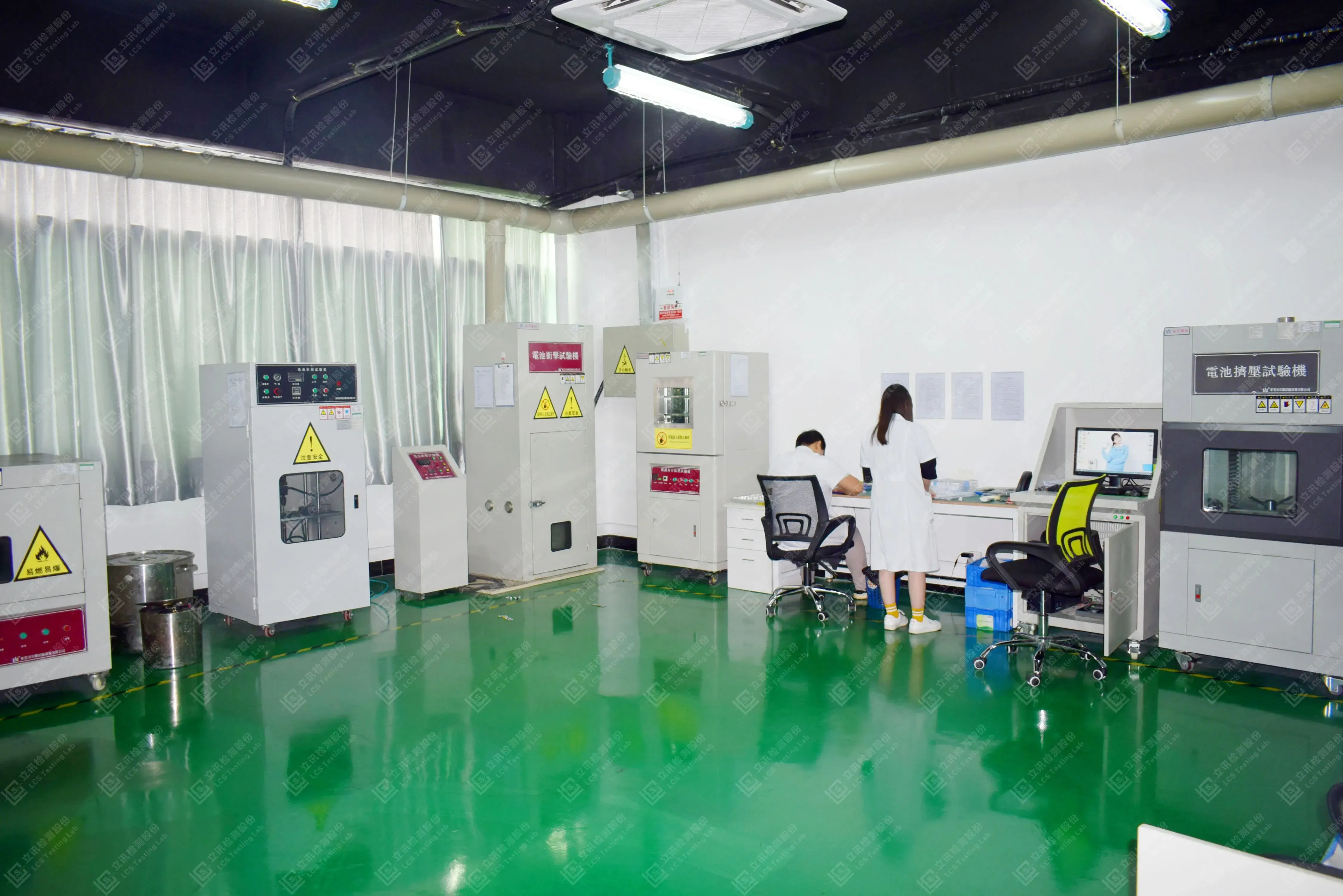
LCS operates a dedicated battery laboratory in Shenzhen covering UN38.3 and related battery standards for cells, packs and energy storage systems. Send your battery specification, capacity and shipping configuration through the contact page, and our engineers will reply with a test proposal.